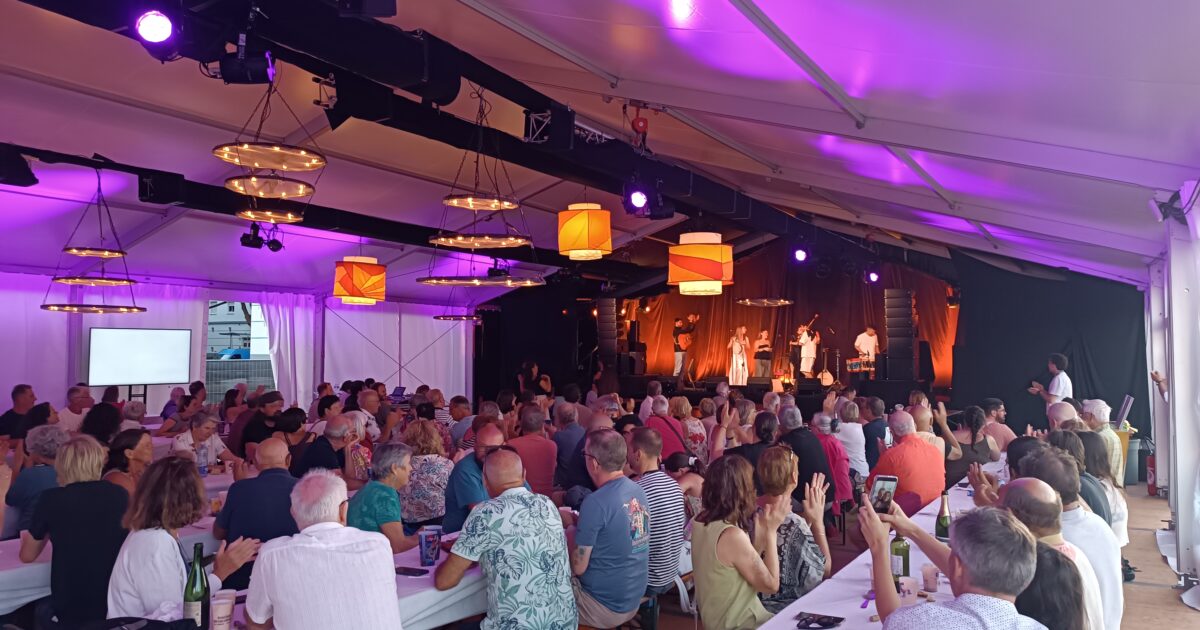
 The 2026 Lorient Interceltic Festival devotes each evening to a dinner-concert celebrating one of the Celtic nations. Traditional dishes, live music and local products turn La Taverne Celte into a gastronomic journey across the Atlantic.
The Lorient Interceltic Festival is not limited to concerts or pipe-band parades. Culture can also be shared around a table. That is the purpose of La Taverne Celte, known as An Davarn Gelt in Breton, a venue located opposite the Quai de la Bretagne which, during the 2026 edition, will host musical brunches and themed dinners dedicated to the different Celtic nations.
Each evening will combine a representative menu with small-scale performances. Brittany will open and close the programme, while Cornwall, the Isle of Man, Asturias, Galicia, Ireland, Wales and Scotland will each have their own night, offering audiences the chance to discover every territory through its flavours and music.
The formula does not attempt to summarise the entire gastronomic diversity of a nation in three dishes. Instead, it offers an introduction through recognisable recipes, products connected to the landscape and musicians able to convey the cultural identity of each place. Food and live performance will share the same space, with neither serving merely as a backdrop for the other.
The first dinner will be devoted to Brittany and will feature cotriade as its main course, a traditional fishermen’s stew prepared with different kinds of fish, potatoes and broth. Guillaume Yaouank, Nordet and Les Calfats du Pays de Lorient will provide the music for an evening linked to the region’s fishing and port heritage.
Naturally, cider could not be absent from this dinner. Breton ciders offer a wide variety of profiles, ranging from dry styles to sweeter and sparkling varieties, and remain deeply connected to the agricultural diversity of the territory.
Cornwall, the featured nation of the 2026 edition, will hold its dinner on 1 August. The menu will include a Cornish pasty, a lobster stew and an apple and blackcurrant crumble. Jen and Toby Kessell and the City of Truro Male Voice Choir will provide the evening’s performances.
The Cornish pasty is closely connected to Cornwall’s mining and working-class history. Its enclosed shape allowed workers to carry a complete meal while keeping the filling protected during the working day.
The Isle of Man will take over the following evening with a menu focused on seafood. Queenies, the small scallops associated with the island, will be followed by clam soup and carrot cake. Becky Hurst and Alasdair Paul will share the evening with An Corran.
Galicia will arrive on 4 August with empanadas, Galician-style octopus and Santiago cake. Benofán and Ailá will offer two different approaches to Galician roots music.
The Irish evening will feature Padraig Jack and the Leonard Barry Trio. The menu will include salmon, Irish stew and cheesecake. The stew will represent a domestic cuisine based on simple ingredients and long cooking times, while the music will demonstrate the continuing vitality of traditional repertoires.
Wales will be represented by Jim Rowlands and Carreg Lafar, with a dinner consisting of cawl, a traditional lamb stew, and teisen lap. The presence of Carreg Lafar will also reinforce the role of the Welsh language within a programme in which music and linguistic identity are closely connected.
Scotland will offer cullen skink, haggis with mashed potatoes and cranachan. Haze and Falasgair will accompany a menu bringing together smoked fish, rural cooking, oats, cream, red berries and whisky.
The Asturian dinner took place on 3 August and will feature Rellume, Entós and singers Alicia Villanueva, Esteban Verdeja and Néstor Díaz. The menu will consist of octopus salad, fabada and either frixuelos or rice pudding.
Fabada will provide one of the most recognisable images of Asturian cuisine. The octopus salad will introduce the connection with the Cantabrian Sea, while the desserts will represent two preparations deeply rooted in the country’s homes and restaurants. Frixuelos will also establish an immediate connection with Breton crêpes, which enjoy a long tradition in the region.
However, the Asturian evening would be incomplete without cider and many people missed it during the dinner. In Asturias, the drink goes far beyond gastronomic accompaniment. The orchard, the cider mill, the espicha, cider pouring and collective consumption form part of a cultural system recognised by UNESCO in 2024 as Intangible Cultural Heritage of Humanity.
Lorient offers a valuable opportunity to present the differences and affinities between Breton and Asturian cider. Both come from Atlantic territories and begin with the fermentation of apples, yet each preserves its own methods, flavours and rituals.
At a festival that brings together thousands of artists and spectators, these meals create a different kind of encounter. Around the table, much of the distance between performers and audiences disappears. Culture is no longer observed only from the stands, but can also be heard, tasted and shared.