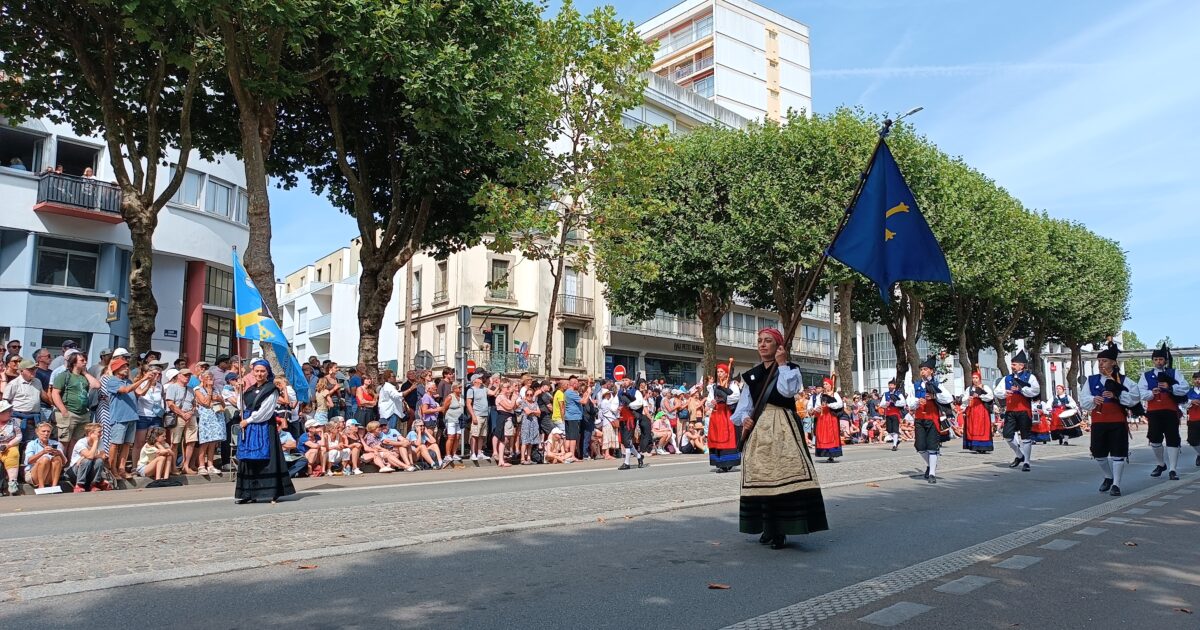
 At ten o’clock on the morning of Sunday, 2 August, the first flags began to move through central Lorient. Behind them came bagpipes, bombardes, drums, dance groups and ensembles dressed in the traditional clothing of their respective territories. The Grande Parade des Nations Celtes once again brought together more than 3,500 performers in one of the central events of the 55th Lorient Interceltic Festival.
The procession crossed the city before entering the Moustoir stadium. From early in the morning, spectators filled the pavements and junctions along the route to watch delegations from Brittany, Cornwall, Scotland, Ireland, Wales, the Isle of Man, Galicia and Asturies. Over the course of a few hours, Breton bagadoù, Scottish pipe bands, bagpipe ensembles, dance circles and groups from across the Atlantic seaboard followed one another through the streets.
Cornwall held a prominent place as the featured nation of this year’s festival, held under the theme “Cornwall, at the Heart of the Celtic Sea”. Its musicians, dancers and flags introduced the public to the culture of Kernow, shaped by the sea, the Cornish language and a musical tradition with numerous historical links to Brittany.
Asturies was represented in the parade by three groups with different backgrounds and characteristics: Banda Gaites El Gumial, from Morea in the municipality of Ayer; Grupu Etnográficu L’Oriente-Llacín, linked to Porrúa and the municipality of Llanes; and Banda de Gaitas La Tarabica, belonging to the Casa de Asturias in Guadarrama, Madrid.
Banda Gaites El Gumial brought the sound of the Aller piping tradition to the parade. Founded in the municipality of Ayer and strongly involved in musical performance and education, the ensemble is one of Asturies’ official representatives at the 2026 festival. Its appearance offered audiences a repertoire centred on the Asturian bagpipe, accompanied by percussion and arranged for a marching band in the street.
The dances and traditional clothing of eastern Asturies were presented by Grupu Etnográficu L’Oriente-Llacín. The group works with dances, music and forms of dress associated with that part of the country, paying attention not only to the steps themselves but also to the social contexts in which they were originally performed. In Lorient, its members presented a tradition in which dance, music and clothing form a single whole.
The third group was La Tarabica, a band founded and developed outside Asturies. Its connection to the Casa de Asturias in Guadarrama makes its participation in Lorient an example of the work carried out by Asturian communities abroad to preserve and pass on their culture. Founded in 2013, the band remains active in the Madrid region and regularly takes part in celebrations and events connected with traditional music.
The three groups offered complementary perspectives. El Gumial represented the strength of the bagpipe-band tradition in central Asturies; L’Oriente-Llacín presented the dances and clothing of the east; and La Tarabica made visible the continuity of Asturian traditions beyond the country itself. Their participation in Lorient provided a broader picture than could have been conveyed by a single group or repertoire.
The Grande Parade is particularly suited to such variety. Each delegation presents its own way of playing, marching and dancing. Scottish pipe bands move in formations very different from those of the Breton bagadoù, while Galician and Asturian bagpipe bands introduce other instruments, ornamentation and rhythms. The succession of groups allows the public to compare traditions without imposing the idea of a single, uniform Celtic culture.
Traditional clothing also plays an important part. Monteras, waistcoats, shawls, headdresses, skirts, aprons and jackets pass before the public in motion, accompanied by the music with which they are associated. Many of these garments have been reconstructed through research, old photographs and original pieces preserved by families and associations.
For a few hours, the parade displays the results of work carried out throughout the year. Behind every group lie rehearsals, music schools, the recovery of repertoires, costume-making and the passing of knowledge from one generation to another. The presence of young performers alongside veteran musicians and dancers confirms that these practices are not preserved merely as memories of the past.
By the time the final groups entered the Moustoir, Lorient had once again brought a significant part of the contemporary Celtic world into its streets. For Asturies, the day had three specific names: El Gumial, L’Oriente-Llacín and La Tarabica—three groups from Ayer, Llanes and Guadarrama sharing the same route, each with its own way of keeping Asturian music and culture alive.