 The 16th International Hall of Gala Ciders unveiled today at Xixón City Hall the remarkable figures for its 2026 edition: 311 products from 117 cider producers across 35 countries. According to the comparable public data reviewed for the main international cider gatherings, no cider show has previously documented a similar concentration of producers, making SISGA’26 the largest edition in its history and the largest documented international cider show to date.
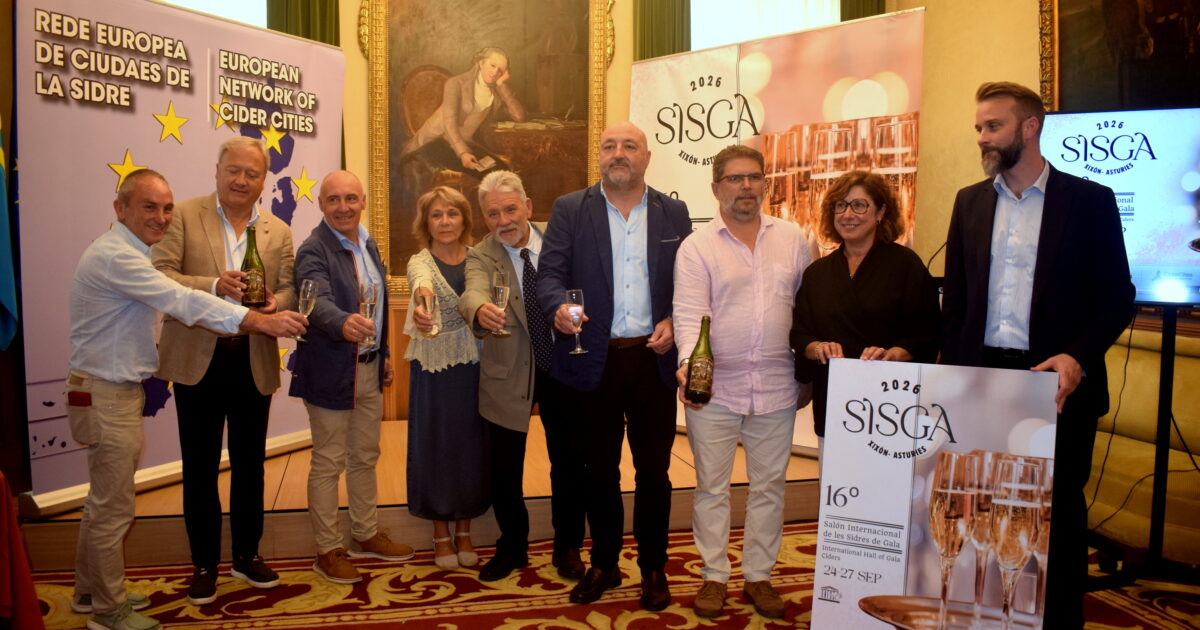
LA SIDRA.- Under the watchful —and, we might say, proud— gaze of Jovellanos, in the Reception Hall of Xixón City Hall, the Asturies XXI Foundation presented this Monday the 16th International Hall of Gala Ciders (SISGA’26), which from 24 to 27 September will once again turn Xixón into a meeting point for international cider culture.
This year, however, there is one factor that makes the edition truly exceptional. The final count reveals figures unprecedented in SISGA’s own history and which, when compared with publicly available data from major international gatherings, place the Asturian event on a scale not previously documented and allow this edition to be described as a world-record SISGA: among the major international cider shows and gatherings for which comparable public figures have been identified, 117 is the highest documented number of participating producers to date. There is a second figure that is equally striking: 35 countries in a single edition, representing a geographical diversity far greater than that recorded at the main events analysed.
The event opened with an address by Guzmán Pendás, Xixón City Councillor for Social Services, Housing and Cooperation, who highlighted the scale SISGA has reached after sixteen years and thanked the Asturies XXI Foundation for the enormous human and logistical effort involved in organising an event of this kind.
Pendás summed up the spirit of this year’s edition in two ideas: SISGA will create “synergy and brotherhood” among cider-producing territories, and it will be a show capable of bringing together three continents, their cultures, their producers and institutional representatives from different cities and countries.
That international institutional presence is precisely one of the dimensions that SISGA has gradually incorporated into its model over the years, moving well beyond the format of a simple product fair.
Carme Pérez, vice-president of the Asturies XXI Foundation, was the person who put the scale of this year’s edition into words: “we have broken every record.”
Pérez highlighted the participation of products from the Americas, Asia and a very broad representation from Europe, noting that such diversity will place Xixón and Asturies at the global epicentre of modern, innovative and new expressions of cider.
She also made clear, however, that SISGA is not simply a succession of bottles and tastings. The event’s DNA lies in bringing producers together “from the apple to the bottle” and building around them a wider framework encompassing gastronomy, tourism, food culture, professional exchange and international cooperation.
That approach has led to projects that now have a life of their own, such as Cider Cities and its international expansion, as well as the European CIDEREU project.
Antonio Migoya, representing the Caja Rural de Xixón Foundation, recalled the long journey travelled and the sustained cooperation between the two foundations. He began with a simple observation: sixteen years is, in itself, already a measure of success, and went on to describe the event as one of the most significant gatherings in the cider world.
Migoya devoted much of his contribution to the economic importance of the cider sector and, above all, to the value of exchange between producers. “You always learn something by getting out of your own surroundings,” was the essence of his message, because discovering other production methods, markets and business models allows cider makers to take new ideas back to their own companies.
This led to the second point he wanted to emphasise: what each producer sees others doing at SISGA can later be adapted, in their own way, to their own cider house, giving the international gathering a direct practical value for the Asturian sector.
Álvaro Alonso, representing the Xixón Chamber of Commerce, congratulated the Asturies XXI Foundation on the work carried out over the years and highlighted two specific dimensions of the Show. The first is economic: bringing representatives from 35 countries and their products to Xixón for several days provides a significant boost to the city’s trade-fair and wider economic activity. Alonso also praised the decision to integrate a substantial part of SISGA into AGROPEC, combining two major events and making full use of the potential of the exhibition grounds.
The second dimension is territorial and international. He recalled the growth of the European network of cider cities, whose governing bodies will meet during SISGA, and stressed the opportunity to establish Xixón as a world capital of cider, not merely a European one.
For Alonso, the value lies in combining the synergies of cities, the product and the primary sector — a strategy that the Chamber sees not only as an opportunity but also as a responsibility in which it intends to remain actively involved.
Gastronomy is another essential pillar of SISGA. Pedro Baldó, from Finca El Duque restaurant, gave a preview of the gastronomic work that will accompany the competition and, in particular, Sunday’s Gala Brunch.
The concept begins with a clear premise: “everything we are going to do will be centred on Asturian products from our own land,” interpreted through contemporary cuisine and designed to accompany the new forms and styles of cider.
Baldó summed up that evolution with another particularly significant idea: cider is evolving, it has new markets and new ways of being consumed. He added that Asturies has professionals capable of being at the forefront of those changes and of exploring new markets and new forms of production.
Closing the round of speeches, Marcos Abel Fernández, president of the Asturies XXI Foundation, placed the figures within the broader international dimension that the project has achieved.
Fernández described the result as “an impressive success” and highlighted what it means to be able to bring together in Xixón a concentration of producers greater than that seen at many of the most widely recognised international events. The intention, he clarified, is not to turn cider into a competition between festivals and shows, but rather to understand the scale of what has been achieved and to be able to say that SISGA is now at the forefront.
His second point went beyond the figures: “right now, we are leading the whole process and the entire international project surrounding cider.” For Fernández, bringing so many producers together means confronting and comparing different ways of growing apples, producing, making, marketing and commercially understanding cider, turning SISGA into an enormous space for mutual learning.
The international development Fernández described can be seen in the Foundation’s participation in practically all the major international cider events and in the relationships the Asturian sector has been developing through other leading cider forums around the world.
On Saturday, SISGA belongs to everyone
Of the extensive programme, the key date for anyone wishing to experience this historic SISGA first-hand will be Saturday, 26 September, when the Show opens its doors to the general public.
The Open Public Tasting will take place in the Salón Asturias at the Congress Centre of the Luis Adaro Exhibition Grounds in Xixón, alongside AGROPEC. There will be two sessions, from 12:00 to 15:00 and from 17:00 to 20:00. Admission costs €10 and gives visitors the opportunity to taste the available international ciders taking part, meet the producers in person and talk to them about their products, enjoy food pairings with Alimentos del Paraíso, and purchase participating ciders directly when available. In addition, six guided tastings will be held, each limited to 20 participants and carrying an additional fee of €5.
This is therefore far more than simply an exhibition. It will be an opportunity to bring together, in a single space, ciders from dozens of territories around the world and the producers behind them; to discover radically different methods of production; and, glass in hand, to travel through a substantial part of today’s global cider map.
It is the moment when the record figure of 311 products, 117 producers and 35 countries stops being merely a statistic and becomes an experience open to the public.
And it is also the best way to understand the scale of what Xixón will host this week: the biggest SISGA ever, the largest documented cider show to date, and an unprecedented gathering of cider cultures.